


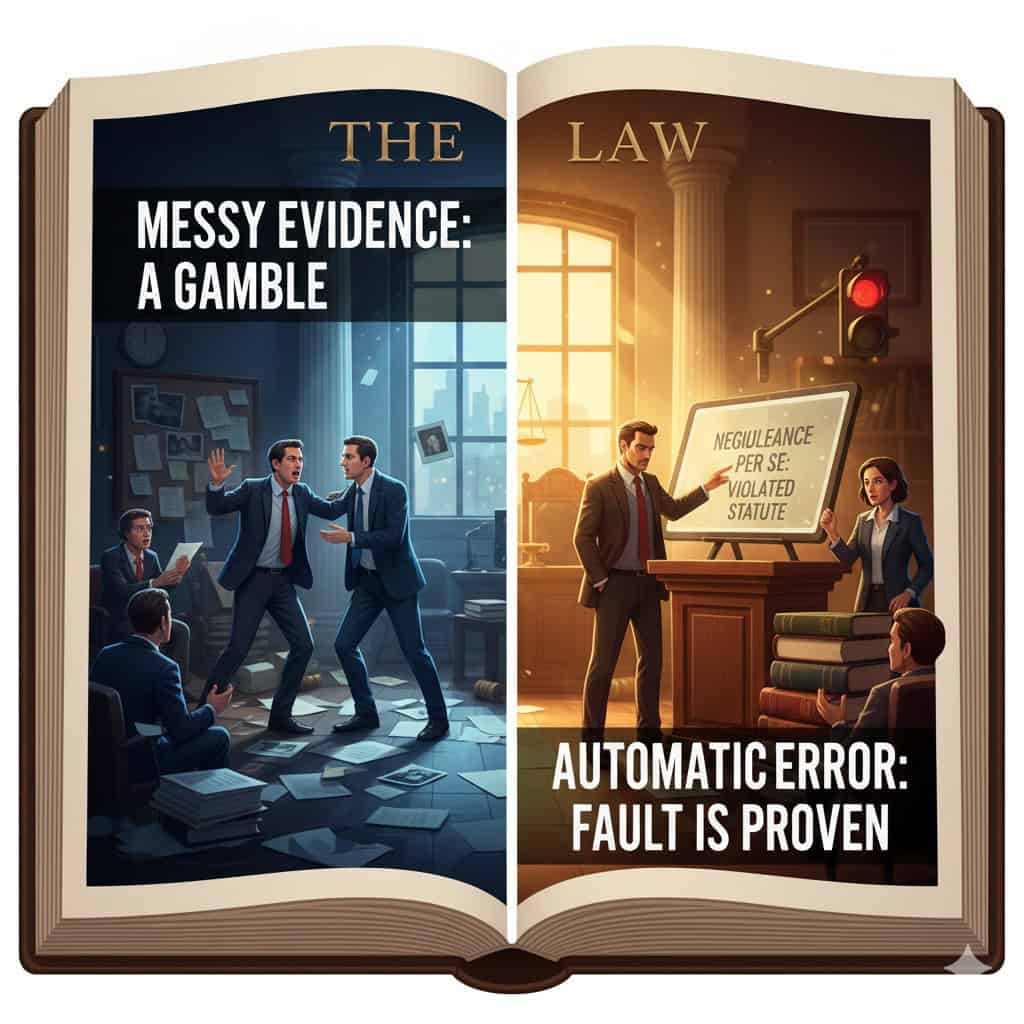
Most personal injury cases are a grueling battle of messy evidence where every minor detail is open to interpretation. Lawyers spend months debating whether a driver was acting reasonably or if a property owner took enough care to prevent a fall. It is a subjective process that relies heavily on a jury’s individual perspective.
This uncertainty makes the legal process feel like a gamble for many victims who just want a clear path to justice. Proving that someone was careless requires digging through thousands of pages of documents and interviewing dozens of witnesses. There is often no single smoking gun that proves responsibility beyond any shadow of doubt.
However, the legal system provides a powerful shortcut when a defendant has violated a specific safety statute during the incident. In these cases, the court applies the doctrine of negligence per se to simplify the entire proceedings. By showing that a law was broken, the victim can bypass the usual arguments about what a reasonable person would have done.
The Specific Criteria for a Violation
The law doesn’t apply this automatic label to every single violation that might occur on the road or in a building. For this doctrine to take effect, the victim must prove that the statute was specifically designed to prevent the type of harm that actually happened. A minor administrative error rarely triggers this kind of legal shortcut in a civil courtroom.
Furthermore, the person who was injured must belong to the specific class of people that the safety law was intended to protect. A law meant to safeguard construction workers might not provide the same automatic fault protections for a random passerby on the sidewalk. The connection between the law and the victim must be direct and undeniable.
Establishing these criteria is the first step in building a case that focuses on a statutory violation rather than a vague sense of carelessness. It requires a deep dive into the legislative history and the exact wording of the safety codes. Once these boxes are checked, the path to a successful judgment becomes significantly smoother and more predictable.
Shifting the Burden of Proof
In a standard claim, the burden is on the plaintiff to prove exactly how the defendant’s actions fell below a reasonable standard of care. This often leads to long and expensive debates about what a normal person would have done in a similar situation. It is an abstract argument that can be difficult for a jury to grasp.
When a safety law is broken, the focus shifts entirely away from reasonableness and onto the simple fact of the violation itself. The question is no longer whether the defendant was being careful, but rather if they complied with the written law. This significantly reduces the amount of evidence a victim needs to present to win.
By removing the need for subjective interpretation, the legal system fast-tracks the determination of fault in a meaningful way. The defendant is essentially considered negligent by default because they ignored a rule that was already established for public safety. This shift in power is a major advantage for any injured party looking for a swift resolution.
Common Triggers for Automatic Fault
Traffic violations are the most frequent triggers for this legal doctrine because the rules of the road are very specific and well documented. Running a red light or traveling thirty miles over the speed limit are clear breaches of safety statutes. These actions are viewed as an intentional disregard for the safety of every other motorist.
Building code failures are another area where the law provides an automatic path to proving negligence for the victim. If a landlord fails to install a required handrail or ignores a fire safety regulation, they are in direct violation of the law. These omissions create a dangerous environment that the statutes were designed to prevent from existing.
Even minor regulations, like those governing the storage of hazardous materials or the labeling of chemicals, can serve as a foundation for a claim. When these rules are ignored, the resulting injuries are seen as a direct consequence of the legal breach. Identifying these broken laws is the key to securing a victory without a long fight.
The Defense of Legal Excuses
While the doctrine of automatic fault is powerful, it is not always the final word in a personal injury trial. A defendant may attempt to offer a rebuttable presumption, which is a legal excuse for why the law was broken in that specific moment. They must prove that compliance was impossible or more dangerous than the violation.
For example, a driver might argue that they swerved across a double yellow line to avoid hitting a child who ran into the street. In this scenario, breaking the law was actually the safer choice to prevent a much larger tragedy from occurring. The court will listen to these explanations to determine if the violation was truly negligent.
However, these excuses are difficult to prove and require a very high level of evidence from the defense team. Most of the time, a broken safety law leads directly to a finding of responsibility for the resulting damages. The burden is on the person who broke the law to explain why they should not be held accountable.
Conclusion
Finding a broken safety law is often the most efficient and effective way to secure a favorable judgment in a civil case. It cuts through the noise of conflicting testimonies and focuses the court’s attention on a verifiable fact. This clarity is a welcome relief for victims who have already suffered enough through the incident.
A successful legal strategy often begins with a thorough investigation of every local and state regulation that might apply to the situation. By identifying a specific violation, a victim can build a case that is much harder for an insurance company to ignore. It provides a level of certainty that standard negligence arguments simply cannot match.
Ultimately, the law exists to protect the public from those who would cut corners or ignore safety for the sake of convenience. Holding people accountable for the rules they break is a fundamental part of the justice system. By using these statutory shortcuts, injured parties can find the closure and compensation they deserve with much less stress.

