


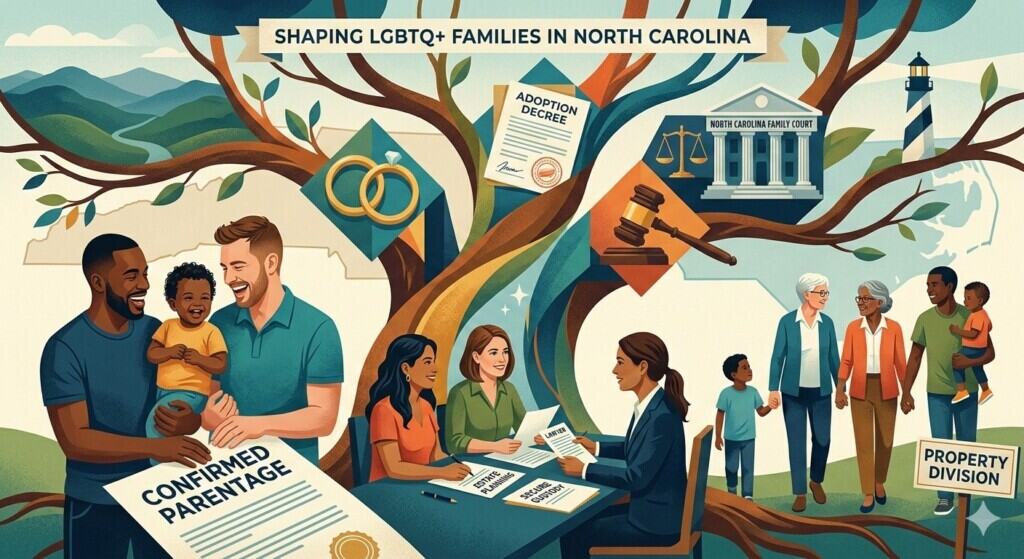
Over the past decade, LGBTQ+ family rights have undergone significant legal transformation in the United States. While marriage equality established federal recognition for same-sex couples, family law remains largely governed at the state level. As a result, questions surrounding custody, parentage, adoption, and divorce continue to evolve.
In North Carolina, recent court interpretations and statutory frameworks highlight how legal protections function in practice and where complexities still arise.
Marriage Equality and State-Level Family Law
The U.S. Supreme Court’s decision in Obergefell v. Hodges guaranteed same-sex couples the right to marry nationwide. However, marriage recognition did not automatically resolve all family law questions.
State courts continue to apply equitable distribution, custody standards, and parentage rules based on state statutes. In North Carolina, family courts evaluate cases using best interest of the child standards, marital property definitions, and established adoption procedures. These frameworks apply equally to LGBTQ+ families, but certain situations may require additional legal clarification.
Parentage and Non-Biological Rights
One area where legal issues frequently arise involves parental recognition. In families formed through assisted reproduction or surrogacy, a non-biological parent may not automatically have enforceable parental rights without formal legal steps.
Even within a valid marriage, courts often rely on documented parentage. Adoption orders or parentage judgments can provide stronger legal standing if disputes arise. Without these safeguards, custody disagreements can become legally complex.
Legal professionals who focus on these matters often emphasize the importance of proactive documentation. Working with an experienced LGBT family lawyer in Charlotte familiar with North Carolina parentage laws can help families ensure their legal rights are clearly established.
Divorce and Property Division
North Carolina follows equitable distribution principles, meaning marital property is divided fairly but not necessarily equally. For LGBTQ+ couples who were together long before marriage equality was recognized, questions sometimes arise regarding how long-term relationships factor into asset division.
Retirement accounts, business interests, and jointly acquired property may require careful analysis. Courts typically consider the legal duration of the marriage rather than the length of the relationship prior to legalization, which can affect spousal support and asset allocation outcomes.
Custody Standards and the Best Interest of the Child
North Carolina courts apply a gender-neutral best interest of the child standard in custody matters. Sexual orientation alone is not a determining factor. However, documentation of legal parentage remains critical.
When both parents have clearly established rights, courts focus on stability, caregiving history, and the child’s overall welfare. Ensuring legal parent status before disputes arise can prevent unnecessary litigation.
Broader Legal Implications
The continued development of LGBTQ+ family law reflects a broader national conversation about equality and uniformity in state-level enforcement. While federal decisions provide foundational rights, day-to-day family matters are still shaped by state courts.
For individuals navigating custody, adoption, or divorce, understanding how state statutes operate in real-world scenarios is essential. Legal clarity often depends on careful planning, proper documentation, and awareness of evolving judicial interpretations.
Looking Ahead
Family law is inherently personal, but it is also deeply procedural. As courts continue to interpret statutes in light of social change, families benefit from staying informed about how legal developments affect their rights and responsibilities.
In North Carolina and beyond, the stability of LGBTQ+ families increasingly depends not only on landmark court decisions but on the practical application of family law at the local level.

