


Every serious injury claim begins with a clear understanding of what happened and who may be responsible. Across Michigan, investigators continue working to reduce roadway injuries as traffic collisions affect thousands of families each year. According to the latest Michigan State Police data, the state recorded 288,880 traffic crashes in 2024, underscoring the importance of thorough investigations when negligence is suspected.
Hirsch Injury Law attorneys build strong cases by gathering evidence, interviewing witnesses, reviewing medical records, and challenging disputed liability when necessary. Acting quickly often allows important evidence to be preserved before accident scenes change or witness memories begin to fade. A well-prepared case not only strengthens a client’s position during negotiations but also provides a solid foundation if litigation becomes necessary.
Early Case Review
Right after a wreck, lawyers review police reports, photographs, repair records, medical notes, and insurance letters. Attorneys may compare driver statements with road conditions, vehicle positions, and treatment timing. This early review can reveal speeding, distraction, impaired driving, unsafe turns, or failure to yield before key facts become harder to verify.
Preserving Key Evidence
Useful evidence can vanish within days. Skid marks fade, vehicles are repaired, cameras record over footage, and memories lose sharp detail. Attorneys send preservation letters to drivers, businesses, insurers, and public agencies. Those requests may cover video, phone data, vehicle modules, maintenance records, and dispatch logs. Early action helps keep important proof from being lost through routine deletion.
Reconstructing The Crash
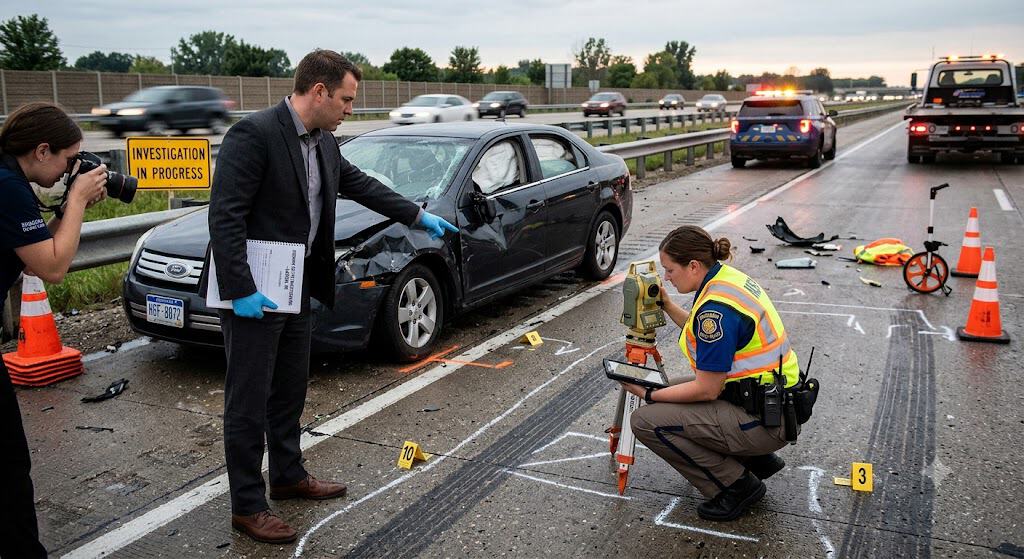
Reconstruction gives shape to scattered physical clues. Attorneys may consult engineers, investigators, or traffic safety experts. They examine impact points, debris patterns, sight distance, lane placement, braking marks, and vehicle crush depth. These details can clarify speed, direction, reaction time, and driver choices. A careful reconstruction also helps counter statements that conflict with the physical evidence.
Proving Negligence
Negligence has several parts. A driver must owe care, break that duty, cause injury, and create measurable losses. Attorneys match each element with proof. A signal violation can show a breach. Imaging, examination notes, or therapy records may show harm. Pay records can support income loss. A strong claim makes every link visible and well supported.
Medical Records Matter
Medical documentation often carries the case. Attorneys collect emergency notes, imaging results, orthopedic findings, therapy records, surgical reports, prescriptions, and future care opinions. They also look at symptom timing. Delayed treatment can raise questions, so lawyers explain gaps with facts such as referral delays or limited access. Consistent records help show pain patterns, nerve symptoms, joint limits, and lasting functional changes.
Witness Accounts
Witnesses can describe unsafe driving before impact. Attorneys speak with passengers, bystanders, first responders, nearby workers, and anyone who saw the moments before contact. Questions usually focus on speed, signals, lane movement, phone use, weather, traffic flow, and driver behavior. Neutral accounts matter because they come from people without a financial stake in the claim.
Digital Proof
Many crashes leave electronic trails. Attorneys may seek dash camera video, traffic footage, business surveillance, vehicle event data, phone records, location history, and ride service logs. This material can show acceleration, braking, route details, or possible distractions. Lawyers must request it correctly because privacy rules, storage limits, and access procedures can affect whether useful data is obtained.
Calculating Losses
Accurate damages require more than adding bills. Attorneys document emergency care, therapy, medication, lost wages, reduced earning capacity, property damage, travel costs, and help needed at home. They also evaluate sleep disruption, anxiety, mobility limits, chronic pain, and reduced household activity. Each category should tie back to records, testimony, or medical opinion. Detailed proof supports a fair demand.
Handling Insurance Tactics
Insurance companies often dispute fault, injury severity, treatment choices, or prior conditions. Attorneys answer with records, timelines, and direct medical explanations. They correct incomplete summaries, challenge weak assumptions, and compare settlement offers with documented losses. If an insurer undervalues the claim, lawyers can prepare litigation. Careful preparation changes negotiations because trial risk becomes harder to ignore.
Building Trial Readiness
Settlement is common, but trial preparation still matters. Attorneys draft pleadings, gather discovery, question witnesses under oath, and prepare exhibits. They organize photographs, timelines, medical proof, expert opinions, and damage summaries. This work shows that the claim can be presented in court. It also protects injured people from pressure to accept offers that overlook proven harm.
Conclusion
Cases against negligent drivers are built through steady, practical work. Attorneys preserve proof, test fault claims, document injuries, calculate losses, and prepare for insurer resistance. Each step strengthens the connection between careless driving and the harm that follows. When evidence is collected early and explained clearly, the injured person’s claim becomes harder to dismiss. That preparation can support fair compensation and meaningful accountability after a preventable crash.

