


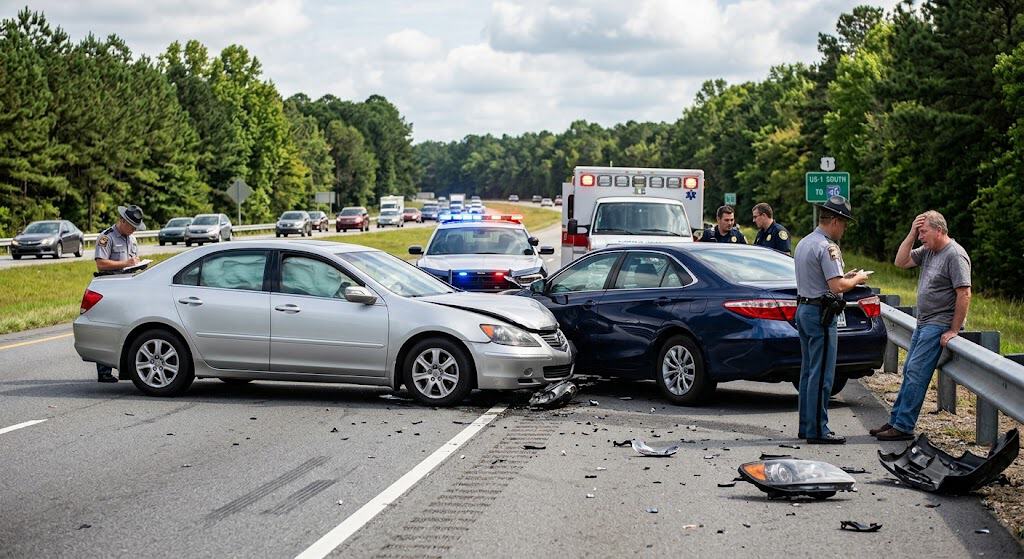
North Carolina drivers are now operating under higher minimum automobile insurance requirements.
For years, the familiar liability limits were $30,000 for injury to one person, $60,000 for injuries to multiple people in one accident, and $25,000 for property damage.
That changed on July 1, 2025.
Policies issued or renewed on or after that date generally must carry at least $50,000 per person for bodily injury, $100,000 per accident for bodily injury, and $50,000 for property damage.
The change gives people injured by negligent drivers access to higher minimum liability limits than before. It does not, however, mean every serious accident is now adequately insured.
What Does 50/100/50 Actually Mean?
The three figures describe separate insurance limits.
The first $50,000 is the maximum liability coverage available for bodily injury to one person under a minimum-limit policy.
The $100,000 figure is the maximum available for bodily injuries to everyone hurt in the same accident.
The final $50,000 applies to property damage.
Consider a collision in which one negligent driver seriously injures three people.
Even if each injured person has more than $50,000 in damages, the minimum policy does not provide $50,000 to each person without limit. The insurer’s total bodily injury obligation is generally capped at $100,000 for the accident.
For someone reviewing a serious crash with Farmer & Morris Law North Carolina personal injury attorneys, identifying both the per-person and per-accident limits can therefore be important before assuming how much liability coverage is actually available.
A policy limit is an insurance ceiling. It is not a valuation of the injury itself.
Why North Carolina Raised the Minimums
The North Carolina Department of Insurance explains that the increased limits resulted from legislation changing the state’s automobile insurance requirements.
The old 30/60/25 limits had remained in place while the cost of vehicles and medical care continued to rise.
Under current law, the required liability limits are now 50/100/50. The North Carolina Department of Insurance notes that the new limits apply to new and renewed policies beginning July 1, 2025.
The increase matters because minimum coverage is often the first source of compensation examined after a crash.
But $50,000 can still disappear quickly after a serious injury.
Emergency care, surgery, rehabilitation, lost income, and future treatment can push a claim well beyond that amount. The gap can become particularly significant in a catastrophic injury involving permanent disability or long-term medical needs.
Underinsured Motorist Coverage Can Matter When $50,000 Is Not Enough
North Carolina’s current insurance framework also requires underinsured motorist coverage.
This coverage addresses a different problem from an uninsured driver.
An uninsured motorist has no qualifying liability insurance. An underinsured driver has insurance, but the available liability coverage is insufficient to compensate for the injured person’s damages.
North Carolina General Statute § 20-279.21 now requires both uninsured and underinsured motorist protection as part of qualifying motor vehicle liability policies.
For example, suppose a driver with $50,000 in bodily injury liability coverage causes injuries reasonably valued well above that amount.
Once the applicable liability coverage is exhausted, the injured person’s own underinsured motorist coverage may become relevant, subject to the policy, statutory requirements, and the circumstances of the claim.
That is why looking only at the other driver’s insurance card may give an incomplete picture.
Multiple Injured People Can Make the Limits More Important
Per-accident limits become particularly significant when several people are injured.
Imagine four occupants of one vehicle are hurt by a driver carrying the minimum 50/100 bodily injury coverage.
The liability insurer does not suddenly have $200,000 simply because four people each have significant claims. The total bodily injury limit for that accident remains $100,000 under a minimum policy.
That can create competing claims against the same pool of insurance money.
Passengers may be in a relatively straightforward position on fault because they were not driving either vehicle, but their insurance issues can still become complicated. Nitkin Law’s discussion of passenger injury claims illustrates how multiple drivers and insurance policies can affect the recovery process.
In a multi-person crash, identifying every potentially applicable policy can become just as important as identifying the responsible driver.
Higher Minimums Do Not Eliminate Coverage Disputes
Having more required insurance does not mean insurers automatically pay policy limits whenever someone is hurt.
The claimant still has to establish liability, causation, and damages.
An insurer may dispute who caused the crash. It may question whether particular medical treatment resulted from the collision. There may also be disagreement about the extent of future losses or whether another policy applies.
The ordinary insurance claim process therefore remains important even after the minimum limits increase.
The legal change affects how much minimum coverage is available.
It does not eliminate the need to prove the claim.
The Date of the Policy Matters
The July 1, 2025 change also makes timing relevant.
The Department of Insurance states that the increased minimums apply to policies newly issued or renewed on or after that date.
For an accident occurring around the transition period, it may therefore be necessary to examine the policy itself rather than simply assume the newer limits applied.
By contrast, drivers purchasing or renewing coverage under the current system are subject to the higher statutory minimums.
The declarations page is usually a much better source of information than guessing from the vehicle, driver, or insurance company.
Better Minimum Coverage Is Still Minimum Coverage
North Carolina’s move from 30/60/25 to 50/100/50 increased the financial protection available under a minimum automobile policy.
That is meaningful.
It should not be confused with a guarantee that sufficient insurance exists after every serious crash.
One injured person can have losses exceeding $50,000. Several injured people may have to look to a $100,000 accident-wide limit. In those situations, underinsured motorist coverage and other potentially applicable insurance can become central to the financial side of the case.
The new numbers have changed.
The basic question after a serious accident remains the same: how much coverage actually applies to the losses caused by this particular crash?
This article provides general information about North Carolina automobile insurance and personal injury law and is not legal advice for an individual case.

