


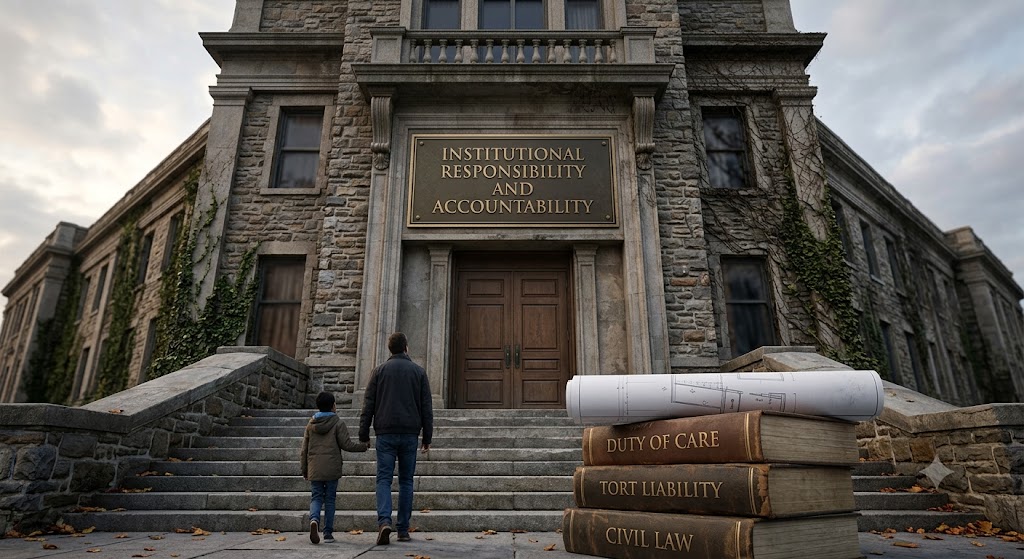
When a case of sexual assault or abuse comes to light, our immediate focus naturally lands on the individual wrongdoer. However, a deeper look often reveals that the perpetrator did not act in a vacuum.
In many instances, the environment around them played a massive role. Institutions like schools, churches, sports leagues, and hospitals hold a legal and moral duty to keep the people in their care safe. When they fail, civil law provides a path to hold them accountable.
Understanding how institutional liability works is a crucial step toward systemic change and healing. Let’s break down why organizations are frequently held legally responsible in these sensitive cases.
What Is Institutional Liability?
Institutional liability is a legal doctrine that holds an entire organization financially and legally responsible for harm that occurs under its watch. This means a school district, a religious organization, or a corporate entity can be sued in civil court if its systematic failures allowed abuse to happen.
Unlike criminal cases, which focus strictly on punishing an individual with jail time, civil lawsuits look at the bigger picture. They ask a simple but heavy question: Did this organization do everything in its power to prevent this tragedy?
Civil law allows survivors to seek financial damages for medical bills, therapy costs, lost wages, and emotional distress. Civil suits operate entirely independently of the criminal justice system, meaning survivors can successfully hold an institution accountable even if criminal charges were never filed or resulted in an acquittal.
How Organizations Enable Misconduct
Institutions become legally liable when their own administrative actions—or lack of action—directly contribute to a dangerous environment. There are three primary ways an organization typically fails its community:
Negligent Hiring and Retention
Organizations are responsible for thoroughly vetting anyone they put in a position of authority. If an institution hires an employee without conducting a background check, or retains someone after receiving credible complaints, they are guilty of negligence.
Inadequate Supervision and Training
Clear boundaries and oversight are the backbone of safety. When a youth group or sports facility fails to train staff on mandatory reporting laws, or leaves adults unsupervised with minors, they create preventable opportunities for abuse.
Cover-Ups and Institutional Concealment
The most egregious liability often stems from an organization actively hiding misconduct to protect its reputation. Shuffling a known offender from one school or parish to another, rather than reporting them to law enforcement, constitutes a severe breach of public trust.
Finding a Path to Healing and Justice
Navigating the aftermath of trauma requires specialized legal support that prioritizes a survivor’s well-being and privacy. For those seeking a path forward in Illinois, the team at Abels & Annes, P.C. provides a trauma-informed environment dedicated to institutional accountability.
The firm understands the delicate nature of these claims, ensuring that every consultation is entirely confidential and free of pressure. Their specialized team breaks down the complexities of state laws, including how extended statutes of limitations and the “discovery rule” protect survivors of childhood abuse.
By focusing on systemic failures, their attorneys have secured multi-million dollar co-counsel recoveries against major entities, including settlements of $3.2 million and $3.15 million involving institutional negligence. For families and individuals trying to piece together what comes next, finding dedicated legal help for sexual abuse survivors is often the first step toward reclaiming their voice and forcing meaningful organizational reform.
According to data compiled by Child USA, a non-profit think tank that tracks civil justice reform, systemic institutional failure is the single greatest predictor of repeated, long-term abuse in organizational settings. This underscores why targeting the entity itself is so critical for public safety.
The Broader Impact of Institutional Lawsuits
Civil lawsuits against large organizations do much more than secure financial support for a survivor’s recovery. They force systemic changes that protect future generations from experiencing the same harm.
“A civil lawsuit forces an institution to look at its policies through a financial lens. When keeping secrets becomes more expensive than implementing real safety measures, the entire culture shifts.”
When an institution faces a high-profile civil claim, it sends a wave of accountability through similar organizations nationwide. These cases routinely trigger vital safety upgrades across entire industries:
- Stricter Vetting: Implementation of mandatory, recurring fingerprinting and federal background checks for all staff and volunteers.
- The “Two-Adult” Rule: Policies requiring at least two vetted adults to be present during any activity involving minors or vulnerable adults.
- Independent Oversight: Establishing third-party reporting channels so complaints bypass internal administrators who might be tempted to hide them.
Ultimately, holding institutions accountable reminds those in power that silence has a steep price, and safety must always come before reputation.

