


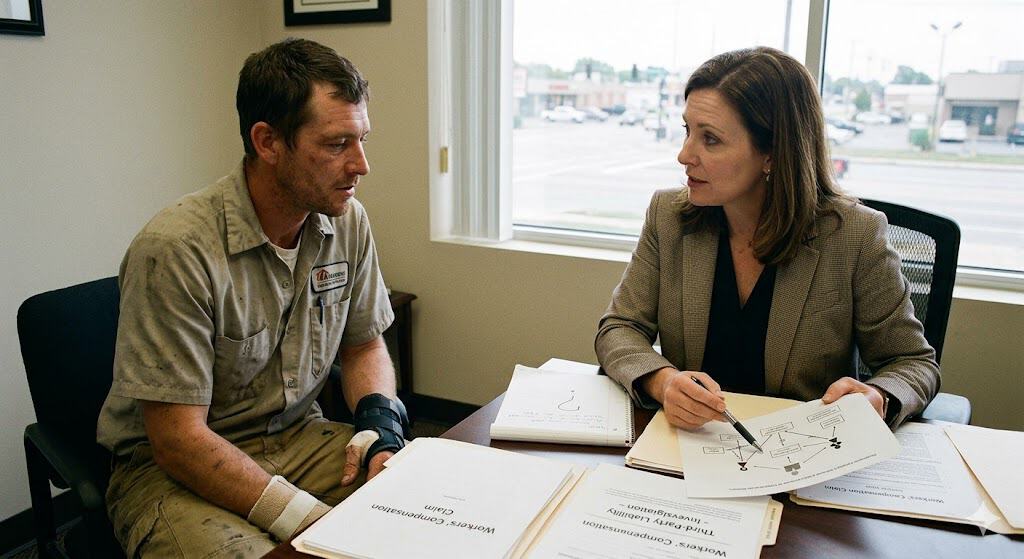
Most injured workers leave money on the table because they focus on workers’ compensation and never ask a bigger question:
What if someone outside your company caused the accident?
That single question can change the value of a case dramatically.
Workers’ compensation is designed to cover medical treatment and part of your lost income. It helps injured employees get benefits quickly without having to prove fault. But it also comes with limits. It does not replace your full paycheck, and it does not compensate you for pain, suffering, emotional distress, or the long-term impact an injury can have on your life. That is why many injured employees choose to speak with a workers’ compensation attorney in Atlanta to determine whether additional legal options may be available.
That is why some workplace accidents involve two separate legal claims, not one.
“The most valuable workplace injury cases are often the ones where workers’ compensation and third-party liability overlap.”
The Core Idea: Workers’ Compensation Is Only Part of the Story
Workers’ compensation protects employees when they get hurt on the job. In exchange for receiving benefits without proving fault, workers generally cannot sue their employer.
That system works well for immediate medical care and wage replacement.
The problem is that many workplace injuries involve people or companies that are not your employer. When that happens, a separate personal injury claim may be available.
A knowledgeable attorney can investigate whether another party shares responsibility for your injuries and whether additional compensation may be available.
Step 1: Identify Whether an Outside Party Played a Role
Many workers assume every workplace injury is solely a job-related claim.
That assumption is often wrong.
Construction projects, delivery routes, warehouses, manufacturing facilities, and commercial properties frequently involve multiple companies operating in the same space.
Ask yourself:
- Was another driver involved?
- Did a defective machine fail?
- Was a subcontractor responsible for the hazard?
- Did the injury occur on property owned by someone else?
If the answer is yes, there may be a third-party claim worth investigating.
Step 2: Understand What Workers’ Compensation Does Not Cover
Workers’ compensation provides important protection, but it has limits.
Benefits typically cover medical treatment, rehabilitation expenses, and a portion of lost wages while you recover. Those payments help stabilize your situation, but they rarely make an injured worker financially whole.
What is missing?
Pain and suffering.
Emotional distress.
Loss of enjoyment of life.
Permanent scarring or disfigurement.
Future losses that extend beyond standard benefits.
These damages are often available only through a separate negligence claim against the responsible third party.
Step 3: Recognize the Most Common Third-Party Injury Scenarios
Third-party liability appears in more workplaces than people realize.
A delivery driver struck by a careless motorist may have a claim against the driver.
A factory employee injured by defective equipment may have a claim against the manufacturer.
A construction worker hurt by another subcontractor’s negligence may have a claim against that company.
An employee injured at a client’s location may have a premises liability claim against the property owner.
Each situation involves a different legal strategy, but they all share one thing in common:
The responsible party is not the employer.
That distinction can open the door to substantially greater compensation.
Step 4: Protect Both Claims From Day One
The first days after a workplace injury often determine the outcome of the case.
Report the accident immediately.
Seek medical treatment without delay.
Document the scene with photographs whenever possible.
Collect witness information.
Keep copies of medical records, work restrictions, and correspondence.
Most importantly, be cautious when speaking with insurance representatives. Statements made early in a claim can be used later to challenge liability or reduce compensation.
“Evidence gathered during the first week after an injury is often the evidence that decides the case months later.”
Strong documentation supports both workers’ compensation benefits and any potential third-party lawsuit.
Why Timing Matters More Than Most Workers Realize
Workers’ compensation claims and third-party injury claims operate under different rules, deadlines, and legal standards.
At the same time, insurance companies may argue over who should pay and how much responsibility each party bears.
There is also the issue of subrogation, which involves reimbursement rights when a third-party settlement is obtained. State laws vary significantly on how these situations are handled and what portion of a recovery an injured worker can keep. Resources such as the Maryland People’s Law Library provide educational information about workers’ compensation systems and employee rights, although the specific rules depend on the state where the injury occurred.
Without experienced legal guidance, important opportunities can be missed.
The Bottom Line
Many injured employees believe workers’ compensation is the only option available after a workplace accident.
In reality, some of the strongest cases involve both workers’ compensation benefits and third-party injury claims.
If another person, company, manufacturer, contractor, driver, or property owner contributed to the accident, a second claim may provide access to compensation that workers’ compensation alone cannot offer.
Understanding that distinction is often the first step toward securing the full financial recovery an injured worker truly needs.

